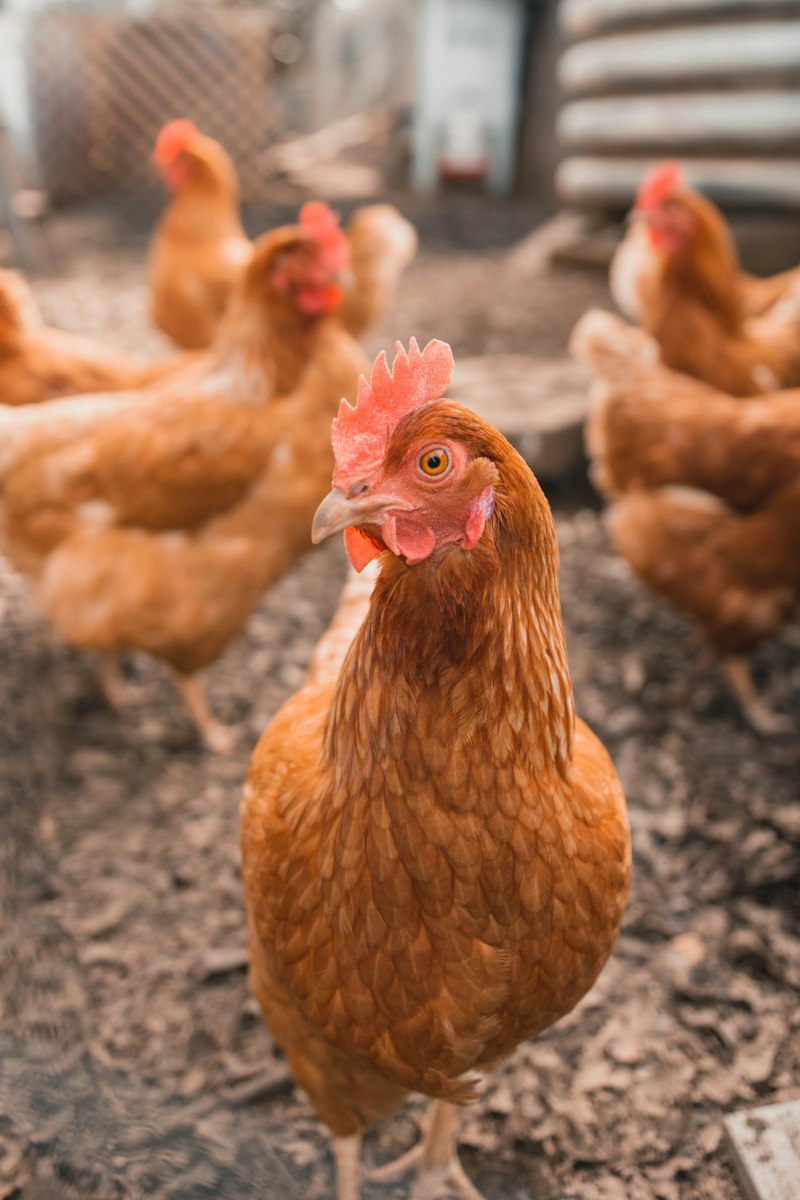
We got chickens last April. My wife wanted them. I said it would be too much work. She was right about wanting them. I was right about the work. We compromised by getting six instead of twelve, which means we now spend exactly the same amount of time on chickens but get fewer eggs. That's marriage in a nutshell, honestly.
I'm writing this because every chicken-keeping article you read online makes it sound like this adorable, simple lifestyle upgrade. "Just get a few hens and enjoy fresh eggs!" they say. What they don't say is that chickens are basically toddlers with feathers and no impulse control, and keeping them alive is a full-time emotional investment.
Here's what nobody told us before we brought those fuzzy little chicks home from Tractor Supply.
The Coop That Cost More Than My First Car
Everyone makes it look so simple online. "Build a coop from pallets in a weekend!" Sure. If you're a carpenter with a fully stocked workshop and no kids running around screaming about dinosaurs. I am not a carpenter. I own a drill and two saws, one of which I'm not sure is safe to operate.
We spent $340 on lumber and hardware for a 4x6 coop that was supposed to be a "simple A-frame design." It took three weekends. The first weekend I cut the wood wrong twice and had to go back to the hardware store. The second weekend it rained. The third weekend I finished it and it looked... fine. Functional. Not the Pinterest coop I'd imagined. More like a shed that chickens live in against their will.
But here's where it gets embarrassing. After building the run — another $180 in hardware cloth and posts — I realized we needed a bigger one. Because chickens don't just want to scratch around in a 10x10 area. They want the whole yard. They want to dig up your wife's flower bed. They want to poop on your porch. They want to investigate every corner of your property with the intensity of a detective at a crime scene.
So we expanded the run. $95 more in materials. Then we added a predator apron because the internet said raccoons would dig under the fence. $40 in hardware cloth. Then we added a automatic door because I was tired of getting up at dawn to let them out. $189 for the door plus $35 for the adapter. Then we added a heated waterer for winter. $45.
Total coop and run cost: somewhere around $924. I'm not adding that up again because the last time I did the math I had to go sit in my car for ten minutes.
What I'd change: Make the roosting bars removable. Cleaning the coop is my least favorite chore and removable bars would make it take five minutes instead of twenty. Also, hardware cloth from day one, not chicken wire. Chicken wire keeps chickens in but doesn't keep predators out. A raccoon will tear through chicken wire like tissue paper and then look at you like "really?"
The Chicken Math Nobody Warns You About
You start with six. That's the plan. "Just six hens," you tell your spouse. "That's plenty for our family."
But then your friend's kid hatches some at school and needs to rehome a couple. And the feed store has those Ameraucanas that lay the blue eggs and they're just so cute. And your neighbor says she's got a broody hen that hatched some chicks and do you want one?
We have eleven chickens now. Eleven. That's almost double the original plan, and it happened so gradually that I can't pinpoint exactly when it went off the rails. Megan says it was when I brought home the two Silkie bantams from the farm auction "because they were only $8 each." I say it was when her coworker gave us three Australorps because she was moving and couldn't take them. Either way, we're now feeding eleven birds and collecting maybe five or six eggs a day, which is more eggs than any one family should reasonably consume.
I've started giving eggs to the mailman. And the UPS driver. And the woman at the post office. I left a dozen on the counter at the hardware store last week with a note that said "from our chickens, please don't arrest us." They didn't.
The Rooster Situation
We don't have a rooster. I want to be very clear about that. We specifically did not get a rooster because roosters are loud, aggressive, and will attack your children. But our barred rock, Sheila, apparently didn't get that memo.
She crows. Not like a rooster — more like a broken car alarm that goes off at random intervals. Sometimes it's 5:30 AM. Sometimes it's noon. Sometimes it's 9 PM, which is just weird. The first time it happened, I ran outside thinking something was wrong. Sheila was just standing there looking proud of herself.
The neighbor, Dave, mentioned the noise. Politely but clearly. "Morning, neighbor. Heard your bird doing her thing again." That's Dave-speak for "I can hear your chicken from my bedroom and my wife is not happy about it."
We started locking them in the coop until 7 AM and that's helped. Sheila still crows through the closed door, but it's muffled enough that Dave hasn't said anything else. I keep waiting for the day he shows up with a formal complaint or a casserole, and honestly I'm not sure which would be worse.
The Egg Reality Check
Here's the part where I have to be honest because every chicken article lies about this. Everyone says "chickens lay an egg a day!" and that's technically true for healthy hens in their first year under ideal conditions. But "ideal conditions" is doing a lot of heavy lifting in that sentence.
Our hens started laying at about 20-22 weeks old. We got maybe 3-4 eggs per day from six hens through the summer and fall. Then fall came, days got shorter, and production dropped to 1-2 eggs per day. By December we were getting one egg every two or three days. Zero eggs in January because the hens were molting, which is when they lose all their feathers and look like prehistoric creatures and spend their time being angry about it.
Spring came and production picked back up, but only to about 2-3 eggs per day because now our hens are in their second year and production naturally declines. We're getting maybe 15-20 eggs a week from eleven birds. That's fine for our family but it's not the cornucopia the internet promised.
The other thing: eggs aren't perfectly uniform. Some are small. Some are weirdly shaped. Occasionally you crack one and it's got a blood spot (totally safe, just gross). You also get the occasional double-yolk, which is fun the first time and then just confusing. But you won't get the perfect, uniform eggs you see at the grocery store. You'll get eggs that look like they were made by a bird, because they were.
The Day the Hawk Got In
I need to talk about the hawk incident because it was the worst fifteen minutes of my life and also the moment I realized I cared more about these stupid birds than I'd ever admit.
It was a Tuesday in October. I was working from home, sitting at the kitchen table with my laptop, when I heard the most unhinged screaming I'd ever heard. Not from me — from the chickens. I ran to the window and there was a red-tailed hawk IN the run. It had somehow gotten through the hardware cloth roof (turns out there was a gap I'd missed) and it was standing on top of Henrietta, who was not moving.
I don't remember making a conscious decision to go outside. My body just did it. I burst through the back door screaming like a banshee — full volume, no words, just primal noise — and the hawk took off so fast it left feathers behind. I stood there in my socks and pajama pants at 2:15 on a Tuesday afternoon, yelling at the sky like a lunatic. Dave was across the street mowing his lawn. He saw the whole thing. He didn't say anything about it, but I know he saw.
Henrietta was alive. Battered, bleeding from a few spots, but alive. We separated her from the flock, cleaned her up, put her in a crate in the garage with food and water, and I checked on her every two hours for three days. She recovered fully. She's still laying, though she lays fewer eggs than the others now, and sometimes she stands in the corner of the run staring at the sky like she's looking for something.
We reinforced the run after that. Added hardware cloth to every surface, every gap, every potential entry point. Trimmed the trees above the run to remove perches. Bought a covered run kit. Total cost: about $120 and my remaining dignity.
The Daily Routine Nobody Talks About
Chicken keeping is a daily commitment. Not a huge one — maybe 15-20 minutes in the morning and 10 minutes in the evening — but it's every single day. No weekends off. No holidays. If you're sick, the chickens still need to be let out and fed and watered.
Morning routine: Open the coop door (they've been staring at you through the window since dawn), scatter some scratch grains in the run, refill water, collect eggs, check for any signs of trouble. Evening routine: Make sure everyone is inside (count them — always count them), close the door, collect any remaining eggs, top off water if needed.
Sounds simple, right? It is, most days. But some days you open the coop and there's a chicken sitting on a pile of eggs she's been hoarding for two weeks. Some days there's a dead chicken and you don't know why and you're standing there with a chicken corpse in your hands feeling like you failed at the most basic level of animal care. Some days the water is frozen solid and you're thawing it with a hair dryer in February while wearing three coats.
And some days — the good days — you open the coop and a chicken walks up to you and makes that soft clucking sound they make when they're content, and you scratch her head and she closes her eyes a little, and you think "okay, this is why I do this."
The Winter Production Drop That Made Me Buy Eggs
I need to talk about January. Specifically, January 2026, when we got exactly fourteen eggs from eleven chickens over the entire month. Fourteen. That's barely one egg a day from a flock that was supposed to be laying regularly.
The hens were molting. Their feathers were falling out in clumps and they looked like they'd been through a car wash. They were grumpy. They stopped laying entirely for three weeks. They spent most of their time huddled in the coop looking miserable.
We bought eggs from the store. I felt like a fraud. Here I was, this "chicken guy" with eleven birds and a coop that cost more than my first apartment's security deposit, and I was standing in the egg aisle at Kroger buying a carton of Great Value eggs. If Dave had seen me, I would have moved to another state.
But that's the reality of backyard chickens. Winter production drops. You're not self-sufficient — you're supplementing. And in January, when it's dark at 5 PM and the chickens are angry about their missing feathers, you buy eggs and you keep your mouth about it.
The Weird Attachment You Develop
Here's the thing nobody tells you about chickens: they have personalities. Real, actual personalities. Our Rhode Island Red, Susan, follows me around the yard like a dog. She comes when I call her (sometimes). She lets Lily pick her up and carry her around the yard like a baby. She's the hen that survived the hawk attack and now she's got this aura of toughness around her, like she's seen things.
There's also Gladys, who is the meanest animal I've ever encountered. She pecks at my ankles every time I go into the run. She bullies the other hens. She once flew at my face when I was reaching for an egg. I've thought about rehoming her at least a dozen times. But she lays the prettiest brown eggs in the flock, so she stays. That's a Faustian bargain if I've ever made one.
You will get attached to these animals. They will follow you around. They will eat from your hand. They will make soft sounds when you talk to them. And one day, something will take one of them, and you'll stand in the yard holding a pile of feathers and feeling something you didn't expect to feel about a bird.
That happened to us. We lost Henrietta's friend, Bertha, to what we think was a raccoon in November. Found feathers, no body. I buried the feathers in the garden because I didn't know what else to do. Lily drew a picture of Bertha and put it on the refrigerator. Megan cried. I didn't cry but I did stand in the backyard for a long time staring at the run.
The Financial Reality
Let me do the math because I know someone's going to ask:
- Coop and run (total, including all the upgrades): approximately $924
- Feed (11 hens, about 50 lbs/month): roughly $550/year
- Bedding (pine shavings, 2 bales/month): roughly $192/year
- Supplements, grit, oyster shell: about $50/year
- Replacement equipment: about $75/year
Egg production: approximately 1,500-1,800 eggs per year (let's say 1,600). That's 133 dozen. At $4/dozen for local farm eggs, that's $532 worth of eggs.
So I'm spending $867 a year to produce $532 worth of eggs. That's a loss of $335 annually, not counting the coop cost. If you amortize the coop over five years, add another $185 per year. Total loss: about $520 per year.
Is it worth it? Financially, absolutely not. I could buy a LOT of eggs for $520. But here's the thing — the eggs are genuinely better. The yolks are this deep orange-yellow instead of pale yellow. They taste richer. They taste like what eggs are supposed to taste like. And my kid runs out to the coop every morning like it's Christmas. That's worth more than $520 to me.
What I'd Change
If I could go back and do this again, I'd buy a pre-built coop unless you're actually good at building things. Save yourself the ego and just buy one. I'm not a carpenter and my coop shows it.
Start with four hens, not six. Easier to manage, fewer eggs to deal with, less drama when one stops laying. Get two breeds that lay well and are docile: Rhode Island Reds and Golden Comets have been great for us. Avoid anything that looks "fancy" unless you want a bird that's pretty but produces two eggs a week.
Put hardware cloth on the run from day one and cover the top. Every surface. Every gap. Assume that every predator in your area is smarter than you and is already planning an attack.
Talk to your neighbors first and bring eggs as a peace offering. A steady supply of fresh eggs makes people surprisingly tolerant of occasional morning squawking. If you don't tell them and they find out on their own, it's a whole different conversation.
Budget $800-900 per year for ongoing costs. That's the real number. Anyone who tells you chickens are cheap is either lying or has a different definition of "cheap" than I do.
And don't name them if you can't handle losing one. We couldn't handle that advice, so now we grieve poultry and have a memorial picture on the refrigerator. Welcome to homesteading.